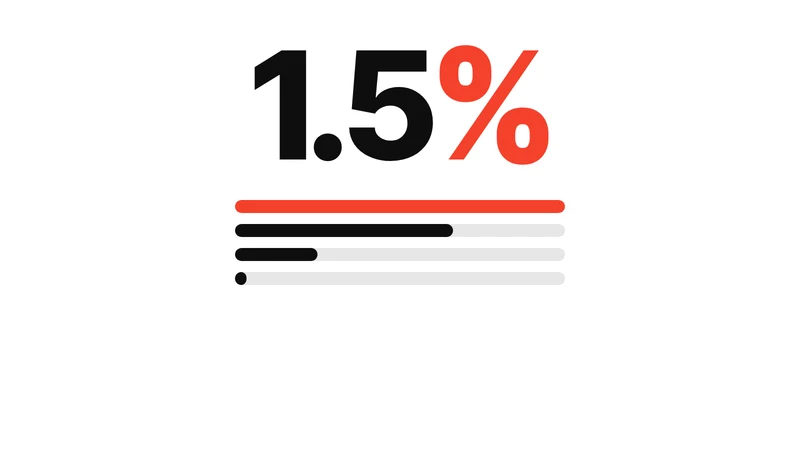
Airbnb's 15.5% single fee: the math, the markup, and what to do next
The split fee is going away for every home host. Repriced properly, the change is close to neutral. Left alone, it quietly cuts your Airbnb payout by about 13%. Here is the arithmetic, the exact markup, and the two other 2026 changes that belong in the same plan.
Key points
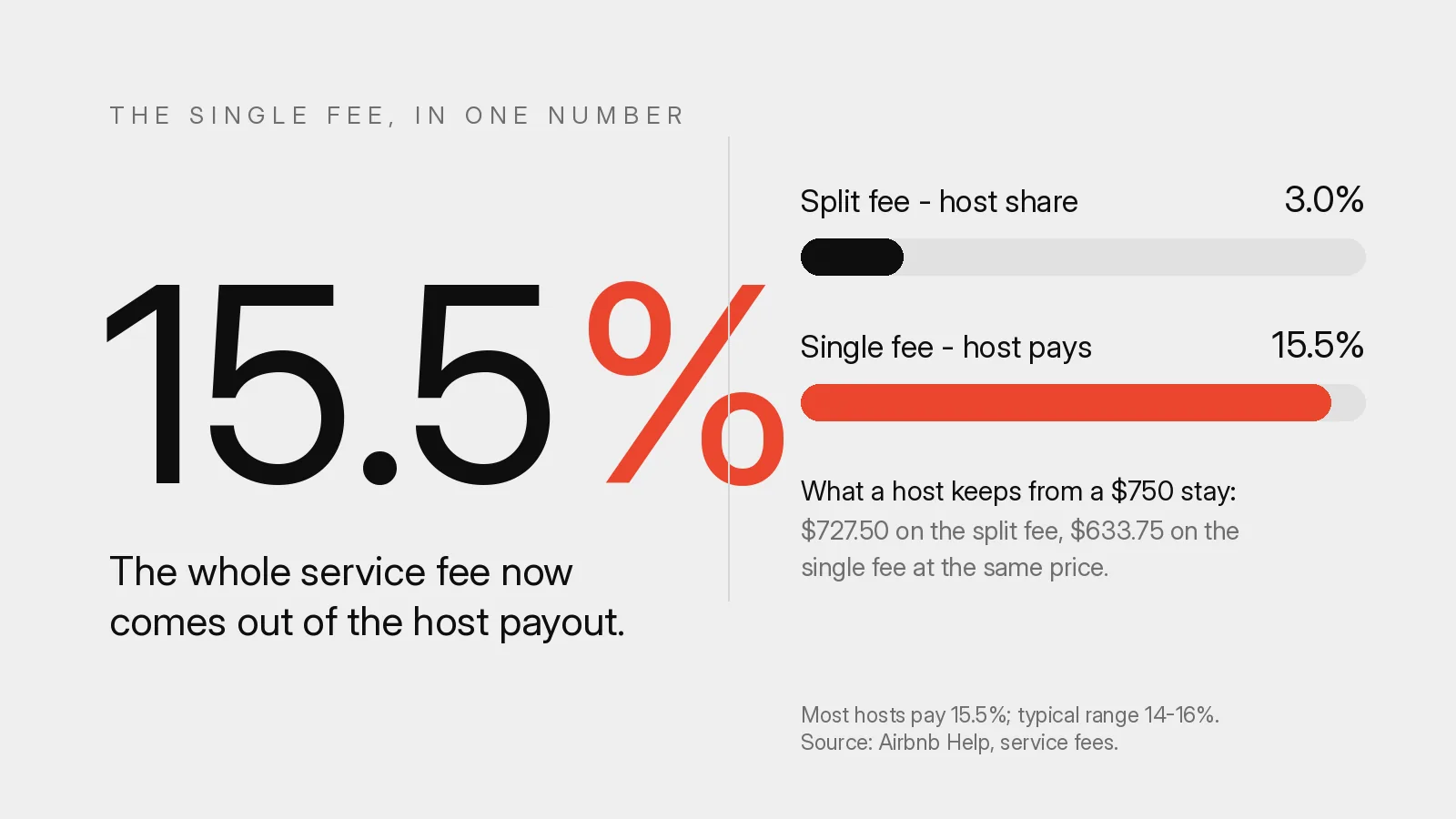
- Airbnb is moving every home host to a single fee of 15.5%, taken entirely out of the host payout. The split fee (3% host, 14.1-16.5% guest) is being phased out, and once you are moved across you cannot switch back.
- Keep your prices where they are and your payout drops by about 12.9%. Raising them by 14.8% restores it, and for most guests the final price barely changes.
- From 20 November 2026, a new house rules policy ends checkout chores: no more asking guests to strip beds, wash dishes or take out the trash. Turnovers become fully yours to staff and pay for.
- Airbnb is also swapping real phone numbers for temporary ones on many US and Canada reservations. The channel owns the guest relationship unless you build a direct one.
Three separate Airbnb changes landed in the second half of 2026, and they point the same way. The fee you pay is changing shape, the chores you can ask guests to do are going away, and the phone number you see for your guest is increasingly not theirs.
None of these is a reason to leave Airbnb; it is still where the guests are. But together they change what an Airbnb booking really costs you and how much of the guest relationship you actually own. This guide does the arithmetic on the 15.5% single fee, shows the exact price rise that protects your payout, and folds in the two policy changes that belong in the same plan.
What actually changed
The fee. Airbnb's help center now says it is "in the process of transitioning all home hosts" to the single service fee structure, with the split fee being phased out1. On the single fee, the entire service fee comes out of the host payout: most hosts pay 15.5%, the typical range is 14% to 16%, and listings in Brazil and Mexico pay 16%. The single fee was already mandatory for hosts using property management software and for traditional hospitality listings; the rollout completes the move for everyone else. Bookings made before you migrate keep the old structure, even when the stay itself is later. And once you have moved, there is no way back.
The house rules. On 20 October 2026 Airbnb announced a new house rules policy that takes effect on 20 November 20262. Checkout instructions fold into a standard set of rules plus "reasonable requests". Asking guests to wash dishes, strip beds or start laundry is no longer allowed; asking them to leave used dishes in the sink or gather used towels is. Requests that break the policy get highlighted in the listing editor, and unresolved ones can put an "includes cleaning requests" alert on your listing that guests can see.
The phone number. On eligible reservations in the US and Canada - including reservations managed through property management software - Airbnb now assigns temporary phone numbers to hosts and guests3. They work for calls and texts, they do not support WhatsApp, and they expire 48 hours after checkout. Guest email addresses were already proxied. For a growing share of bookings, the marketplace is the only address book you have.
One direction connects all three: Airbnb is standardizing how price, rules and contact work on its platform. The sensible response is not outrage. It is to re-run your own numbers and rebalance where your bookings come from.
The fee math, without the fog
Under the split fee, most hosts paid 3% and the guest paid a service fee of 14.1% to 16.5% on top of your price1. Under the single fee, the guest pays no service fee at all and the host pays 15.5%. Both structures calculate the fee on the same base: the nightly price plus any fees you charge, such as cleaning or extra guest fees, excluding taxes.
Here is a three-night stay at $200 a night with a $150 cleaning fee - a $750 fee base - under each structure. These are worked examples to show the arithmetic, not data from any real listing.
| Three nights, $200/night + $150 cleaning | Split fee (old) | Single fee, price unchanged | Single fee, repriced +14.8% |
|---|---|---|---|
| Your fee base | $750.00 | $750.00 | $861.00 |
| Guest service fee | $105.75 to $123.75 | $0 | $0 |
| Guest total before tax | $855.75 to $873.75 | $750.00 | $861.00 |
| Airbnb's cut from you | $22.50 | $116.25 | $133.46 |
| Your payout | $727.50 | $633.75 | $727.54 |
Read the middle column first. That is what happens if you do nothing: the guest pays $750 instead of up to $873.75, Airbnb still takes 15.5%, and your payout falls from $727.50 to $633.75 - a 12.9% pay cut you never agreed to. On $40,000 of Airbnb bookings a year, that is roughly $5,160.
Now the right-hand column. To keep the same payout, divide your old payout rate by the new one: 0.97 / 0.845 = 1.148. Raise your prices by 14.8% and you are whole. The guest's total lands at $861, inside the $855.75 to $873.75 range they would have paid under the split fee. Guests who were paying the low end of the guest fee pay a little more; guests who paid the high end, including many cross-currency bookings, pay a little less.
Leave prices as they are
$633.75
Your payout from the $750 stay
Guest pays $750, the cheapest of the three. You absorb the entire change: 12.9% less per booking, forever.
Reprice by 14.8%
$727.54
Your payout from the $861 stay
Guest pays $861, inside the old $855.75-$873.75 range. Your payout is restored, Airbnb's take rises with the price.
To be fair to Airbnb, its case is not nothing. A single price with no service fee added at checkout is easier for guests to compare, and hotels and PMS-connected listings have priced this way for years. The company is also right that the guest total barely moves if hosts reprice. The catch is that repricing is your job. The host who never opens their settings quietly funds the transition, and a listing that gets relatively cheaper can fill its calendar while paying its owner less.
How to reprice without guessing
- Work out your multiplier. Moving from the 3% split fee to 15.5%, it is 0.97 / 0.845 = 1.148, a 14.8% rise. If your old host fee was different (4% in Brazil and Mexico), use your own numbers: (1 minus your old fee) / (1 minus your new fee). Your new fee is 15.5% for most hosts but 16% in Brazil and Mexico, where a 4% old fee gives 0.96 / 0.84 = 1.143, a 14.3% rise.
- Apply it in exactly one place. If you price inside Airbnb, raise the nightly rate and your fixed fees there. If you use a property management system, most have a channel markup or adjustment field for Airbnb - set it there. If a pricing tool such as PriceLabs or Beyond pushes your rates, check whether its Airbnb adjustment already does this. Double-applying the markup in two systems is the most common way this goes wrong.
- Watch the next two to four weeks. Every host in your market faces the same change, so if everyone reprices, nobody's relative position moves. Watch your views-to-bookings conversion and pacing, not the fee line.
- Re-check the fee base. The single fee applies to your cleaning fee and other charges too, so a $150 cleaning fee now carries $23.25 of Airbnb fee. Some operators fold more of the cleaning cost into the nightly rate so the price looks leaner in search. If you do, keep the total honest - guests notice.
Run your own numbers
Free OTA commission and repricing calculator - Airbnb, Booking.com, Vrbo and direct, side by side. No signup.
From 20 November, turnovers are yours again
The house rules policy formalizes something guest reviews had already been punishing: the checkout chore list. From 20 November 2026, guests cannot be asked to wash and put away dishes, strip beds, start a load of laundry or take rubbish off the property2. You can still ask for reasonable things: dishes in the sink, towels gathered, recycling separated into indoor bins, doors locked, the air conditioning turned off at departure.
Two practical consequences. First, audit your house rules in the listing editor before the deadline. Airbnb says it will highlight requests that break the policy, and listings with unresolved issues can carry that guest-facing "includes cleaning requests" alert - a conversion tax on top of the fee change. Second, put a real number on your turnover. If your cleaner was topping up what guests used to finish, that slack is gone. Operators are increasingly scheduling turnovers through tools like Turno or their PMS, with photo checklists and a backup cleaner on call, because the quality bar now sits entirely on your side of the ledger. Host reaction has been split between relief at clearer rules and anxiety about turnover costs, as the BBC's coverage of the change captured5.
The quiet one: who owns the guest
The fee will get the headlines, but the contact change may matter more over five years. With temporary phone numbers rolling out across US and Canada reservations - expiring 48 hours after checkout, with no WhatsApp support - and guest emails already proxied, Airbnb increasingly owns the only working channel to your guest3. When the number dies two days after checkout, so does your easiest route to a repeat booking.
Hosts have answered this the same way for a decade: make the direct relationship worth having while the guest is with you, and give past guests an easy way back. A welcome guide that carries your brand. A returning-guest rate they can actually find. A site that answers the questions a marketplace listing cannot. Stay inside the platform's rules - never try to move an active Airbnb booking off-platform - but nothing stops a happy past guest from choosing you directly next time. Our direct booking website guide covers the trust side, the conversion rate article shows how to measure whether it is working, and the direct booking savings calculator shows what shifting even one booking in five is worth on your numbers. After the fee change, that number went up for most hosts.
What to do this week
- Check your status. Open a recent Airbnb payout and look at the service fee line. The help pages confirm whether you are still on the split fee or already migrated.
- Set your markup. 14.8% if you were on 3%, applied once, in one system.
- Fix your house rules before 20 November. Remove anything a cleaner should do; keep the reasonable requests.
- Re-cost your turnover. Cleaner time, laundry, consumables - then decide what stays in the cleaning fee and what moves into the nightly rate.
- Give past guests a way back. One touchpoint - a guidebook, a returning-guest email - that makes rebooking direct the easy option.
See what the fee change is worth to you
Free direct booking savings calculator. No signup.
Sources
- Airbnb Help: Airbnb service fees (split fee and single fee structure)
- Airbnb Resource Center: Important changes to house rules (20 October 2026)
- Airbnb Help: Temporary phone numbers
- CNBC: Airbnb's fee change frustrates hosts - what to know before listing (22 August 2026)
- BBC: No more washing up - how Airbnb's new house rules have divided hosts and guests (1 November 2026)
- BiggerPockets: "Airbnb 15.5% is coming to all of us" - operator discussion (October 2026)
Last checked 3 November 2026. Fee percentages, rollout timing and policy details change; confirm on the Airbnb sources before you act. The worked examples use invented figures to show the arithmetic and are not data from AccomStack or any operator. All graphics were made by AccomStack; the article uses no third-party photos or screenshots. Vendors are named as examples, not endorsements, and AccomStack has no affiliate relationship with them. This article is general information, not legal, tax or financial advice.